I didn’t set out to spend $300 on markers. That’s the thing about art supplies. It happens in twenty and forty dollar increments over a couple of years, and then one afternoon you’re organizing your desk, you add it up, and you feel slightly sick.
So I did the honest accounting. Every set, every impulse single, every refill. And I sorted it into two piles: things I’d buy again without hesitating, and things I genuinely regret.
If you’re looking for a best art markers honest review that isn’t just a polished list of products with affiliate buttons, this is my actual spending history with the mistakes left in.
Quick note before we start: I’m giving approximate amounts from when I bought things. Marker prices move around a lot and vary hugely by country and retailer, so treat the numbers as rough context, not a current price list. The lessons matter more than the figures.
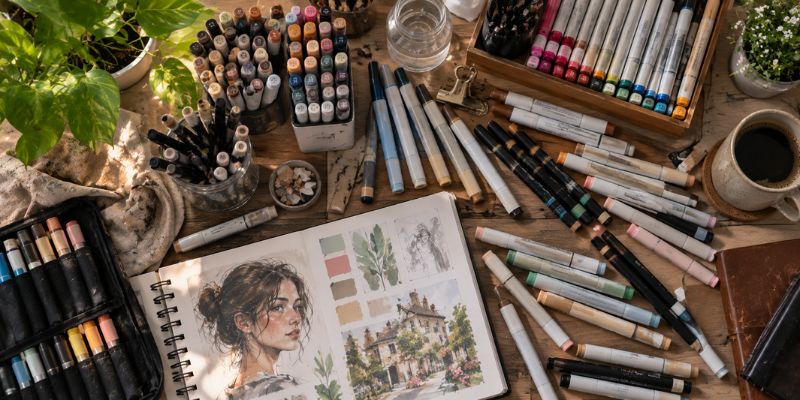
How the $300 Actually Broke Down
It was never one purchase. That’s the trap. Broken down roughly, it looked like this:
- A premium alcohol marker investment, built up slowly a few markers at a time. This was the largest single chunk of the total.
- A mid-tier set bought all at once, on the logic that a bigger set meant better value.
- A budget set from an online marketplace, bought partly out of curiosity.
- Refills, replacement nibs, and a scattering of impulse singles that added up quietly.
Written out like that, the pattern is obvious. The money didn’t go where I thought it went. A surprising amount of it disappeared into sets I bought before I knew what I’d actually use, which is the single most expensive mistake in this whole story.
What Was Absolutely Worth It
Some of this money bought things I still use almost every week. Here’s what earned its place.
The premium alcohol markers. I resisted these for a long time on price alone, and I was wrong. The argument isn’t that the ink is magic. It’s that they’re refillable and the nibs are replaceable. A marker you can refill stops being a disposable purchase and becomes a tool you maintain.
Over a couple of years, the refill math genuinely closes a lot of the price gap. The ink flow also stays consistent from the first stroke to the last, which matters more than it sounds when you’re laying down flat color and a marker suddenly starts streaking on you.
If you want the full breakdown of what that price actually pays for, I’ve written about it separately, and Copic’s own refill and nib system is worth reading about before you decide.
A colorless blender and a small set of neutral greys. Disproportionately useful. Greys do the quiet work in almost every drawing, and I reach for them far more than any bright color I own. If I could only keep ten markers, most of them would be greys.
Good paper. I’m putting this in the worth-it section even though it isn’t a marker, because it changed my results more than any marker upgrade did. More on that below.
What Was a Waste of Money (The Regrets)
This is the useful part, so I’ll be blunt.
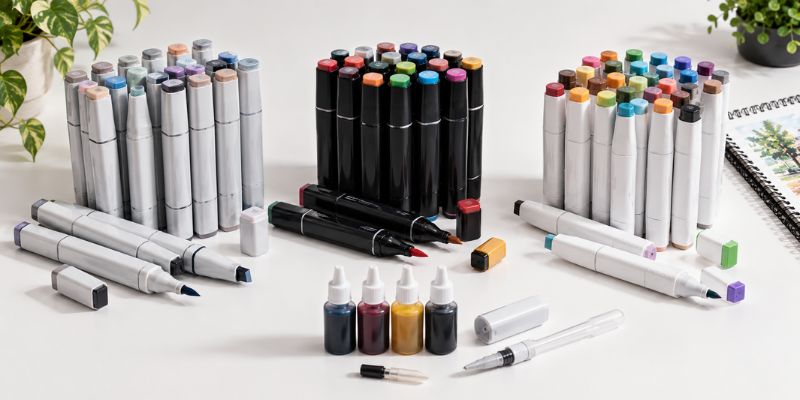
The oversized set. I bought a large set because the per-marker price looked like a bargain. Two years later, a solid portion of those colors have never touched paper.
There were four greens I couldn’t tell apart and a run of neons I’ve used exactly once. Color count is a marketing number. It is not a value metric, and I fell for it completely.
Impulse specialty markers. Metallics, a couple of odd novelty tips, one marker I bought purely because the packaging was nice. All of it sits in a drawer. If I can’t name the specific drawing I want a marker for, I shouldn’t be buying it.
Full sets bought before I knew my palette. This is the real lesson underneath both mistakes above. I didn’t know which colors I gravitated toward until I’d been drawing regularly for a while.
Buying big sets early meant paying for someone else’s idea of a useful palette instead of building my own.
One very cheap set that dried out. Not all budget markers are bad, and I’ll defend the good ones in a moment. But one set I bought had inconsistent nibs out of the box and a couple of markers that were half-dry from day one.
Cheap is fine. Unreliable is not.
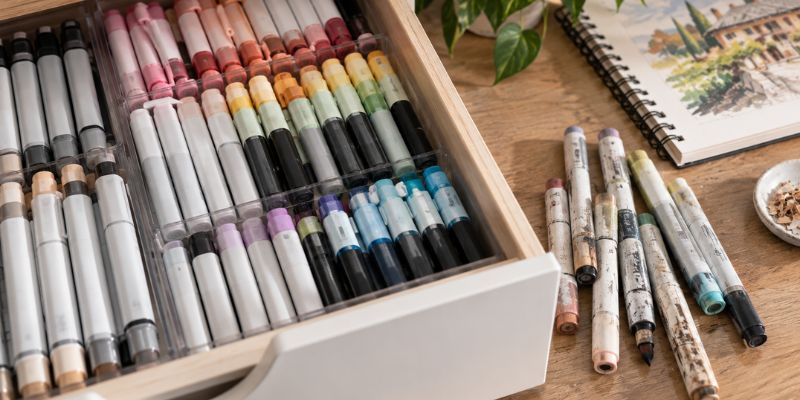
Cheap vs. Expensive Markers: What the Money Actually Buys
I want to be fair here, because marker snobbery is unhelpful and mostly wrong.
What you genuinely get by paying more: consistent ink flow, refillability, replaceable nibs, better color accuracy between batches so a marker you rebuy matches the one you had, and generally better lightfastness.
Those are real, practical advantages if you draw often.
What you do not get: better drawings, if your technique isn’t there yet. An expensive marker in an untrained hand still produces streaky, muddy blending.
I know because I owned expensive markers before I knew how to use them, and my work didn’t improve until my technique did.
Budget markers are genuinely fine for learning, practice, and filling sketchbooks without guilt. Some of the solid budget alcohol markers available now blend far better than the cheap markers I grew up with.
If you’re weighing two specific big names, how the two brands compare directly will help more than a general price argument.
The Thing Nobody Tells You: Paper Matters More Than Brand
If I could go back and redirect part of that $300, this is where it would go.
Cheap markers on good marker paper beat premium markers on copy paper. Not slightly. Obviously and immediately.
On the wrong paper, ink bleeds through, feathers out past your lines, and dries too fast to blend, and every one of those problems reads as a marker problem when it’s actually a paper problem.
Good marker paper gives you a longer blending window, cleaner edges, and no bleed-through ruining the next page. It’s the cheapest upgrade available with the most visible difference.
Picking the right paper for alcohol markers will do more for your results this week than any brand upgrade will.

What I’d Buy With $300 Today
If someone handed me that money again with the knowledge I have now, here’s roughly how I’d split it. I’m keeping this to principles rather than exact products, because prices and availability vary a lot depending on where you live.
- A modest core set of quality alcohol markers. Small, not sprawling. Weighted toward greys and a handful of colors I know I use.
- A colorless blender. Cheap, and it does more for smooth transitions than adding ten more colors would.
- A serious chunk of the budget on good marker paper. More than feels reasonable. This is the part past-me would have argued with, and past-me was wrong.
- A handful of individually chosen singles. Bought one at a time, as I actually run out of a color or find a gap in my palette.
- Money deliberately left unspent. Held back for refills, replacement nibs, and the colors I’ll discover I need in six months.
That last line is the whole lesson. Leaving money unspent is a strategy, not a failure to shop.
How to Avoid Overspending on Markers
A few habits that would have saved me a lot:
- Buy small and build slowly. Add singles as you exhaust colors, not in anticipation of using them.
- Pay attention to which markers actually run low. That’s your real palette, and it’s probably narrower than you’d guess.
- Ignore color-count marketing entirely. Sixty colors you don’t use is worse value than twelve you do.
- Test blending before committing to a brand, even if it’s just a few singles first. Learning to test blending properly tells you more about a marker than any review, including this one.

Common Questions About Buying Art Markers
Are Copic markers worth it?
They’re worth it if you draw regularly and value refillability, replaceable nibs, and consistent ink flow. For occasional hobby use, budget alcohol markers perform well enough that the premium is hard to justify.
What are the best cheap alternatives to Copic?
Several budget alcohol marker lines blend surprisingly well for a fraction of the price. The main trade-offs are refillability and batch-to-batch color consistency, not blending quality.
Should beginners buy expensive markers?
No. Start with an affordable set plus genuinely good paper, then upgrade selectively once you know which colors you actually reach for.
How much should I spend on art markers?
Far less than $300 to start. A modest set and quality marker paper covers most beginners comfortably, with room to add singles later.
Do expensive markers blend better?
Somewhat, thanks to more consistent ink flow. But paper quality affects blending more than marker price does, which is why cheap markers on good paper often outperform the reverse.
If You’re About to Click Buy
Looking back, the money itself isn’t what bothers me. Art supplies are a reasonable thing to spend money on, and I’ve gotten years of use out of the good purchases. What bothers me is that I bought most of it before I had any idea what I’d actually use.
So start smaller than you want to. Draw with what you have until something specific frustrates you, then buy the thing that fixes that specific frustration. Your sketchbook will tell you what to buy next far more reliably than any review will, mine included.
And if you’re still deciding between brands, browse ChooseMarker’s other marker guides before you spend anything. Ten minutes of reading is cheaper than a set you’ll never open.
