
You’re standing in an art store or maybe you’re scrolling through pages of sketchbooks online and they all look pretty much the same. Different covers, different prices, but you genuinely have no idea which one is right for you. Sound familiar?
I’ve been there. And I’ve also bought the wrong sketchbook more times than I’d like to admit. The paper warped every time I used watercolor. The pages were too thin and ink bled straight through. It was frustrating and it actually made me want to draw less.
Here’s the thing: knowing what to look for when buying a sketchbook makes a real difference. The right sketchbook for your medium and drawing habits will make you want to open it every single day. The wrong one will just sit on your shelf collecting dust.
So let’s go through exactly what to look for one thing at a time. By the end of this, you’ll know exactly which sketchbook to buy.
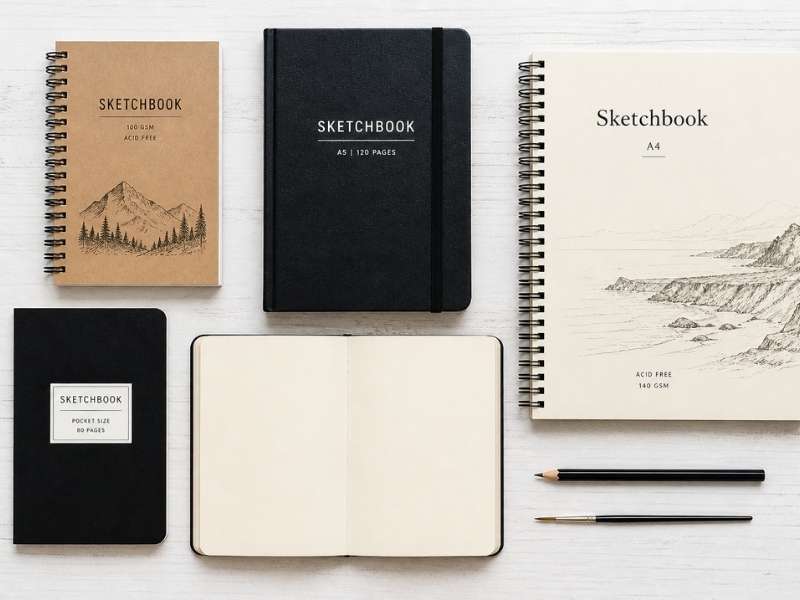
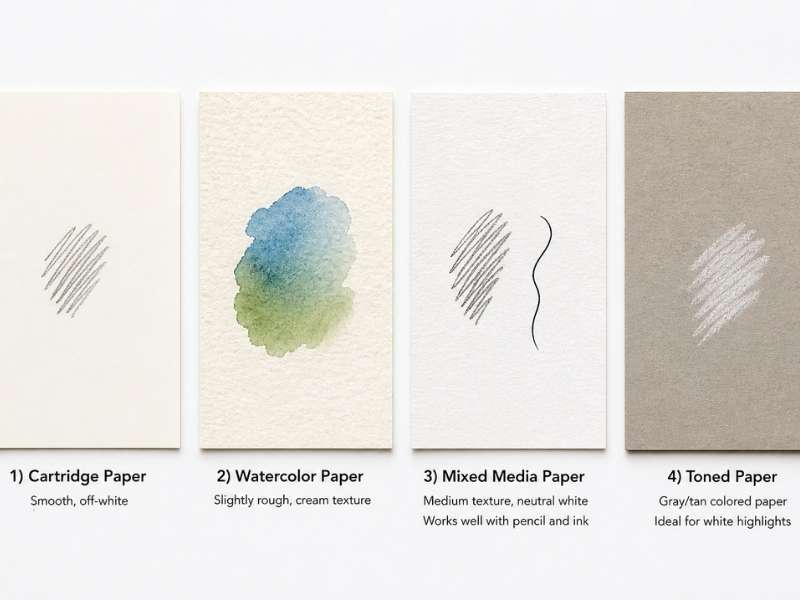
Paper Type: The Most Important Factor
Before you think about size or price, think about paper. Because the wrong paper for your medium will ruin your experience, no matter how beautiful the sketchbook looks on the outside.
Paper type determines which drawing tools will work well in your sketchbook and which ones will make the paper buckle, bleed, or tear. Let me break down the main types.
Cartridge Paper: Best for Pencil, Pen & Charcoal
Cartridge paper is the standard paper you’ll find in most beginner sketchbooks. It has a smooth-ish surface with a slight texture what artists call paper tooth which gives pencil something to grip without being too rough. It’s usually between 90 and 130 GSM, lightweight and easy to work with.
It’s great for pencil, pen, charcoal, and colored pencil. The one thing you should know: cartridge paper is NOT designed for wet media. If you try to use watercolor on it, it will buckle and warp badly.
If your main tools are pencils or pens, this is your go-to paper. Look for acid-free paper even in cartridge sketchbooks it keeps your drawings from yellowing over time.
Watercolor Paper: Best for Wet Media
Watercolor paper is thick and textured, built to handle a lot of water without falling apart. It usually starts at 200 GSM and goes up to 300 GSM or more. You’ll see it in three surface types: Hot Press (smooth), Cold Press (medium texture), and Rough.
Cold Press is the most popular choice for beginners it’s textured enough to give character to a wash but not so rough that it fights pen work.
If you use watercolors, gouache, or ink washes in your sketchbook, you genuinely need watercolor paper. A sketchbook for watercolor doesn’t have to be fancy but it does need to meet that 200 GSM minimum.
At 300 GSM, you usually don’t even need to stretch or tape the paper before painting, which is a huge convenience.
Mixed Media Paper: Best for Artists Who Use Everything
Mixed media paper sits right in the middle heavier than cartridge, lighter than dedicated watercolor paper. Usually 160 to 200 GSM. It handles pencil, ink, light watercolor washes, and markers without too much trouble.
A mixed media sketchbook is genuinely one of the best recommendations I can make for a beginner who isn’t sure what their style is yet. It gives you flexibility while you figure things out.
Toned Paper: Best for Highlights and Contrast Work
Toned paper comes in mid-range colors most commonly gray, tan/brown, or black. Instead of starting from white, you start in the middle tonal range.
This means you can add both dark shadows and white highlights in the same drawing, which completely changes how you think about light.
A toned paper sketchbook is especially great for portrait sketching, figure drawing, and charcoal work. It feels advanced, but it’s actually a fantastic way to understand light and shadow faster.
I’d recommend trying one once you’re comfortable with a standard white sketchbook.
Paper Weight (GSM) — What the Numbers Actually Mean
GSM stands for grams per square meter. It’s simply a measure of how thick and heavy the paper is.
Higher number = thicker paper = better at handling more media without bleeding, tearing, or warping.
That’s really all you need to know at the start.
Thin paper bleeds with ink. It tears when you erase. It warps badly if any moisture touches it. Thicker paper is more forgiving, survives erasing, and lasts much longer. The sketchbook paper weight you choose should match the tools you’re planning to use.
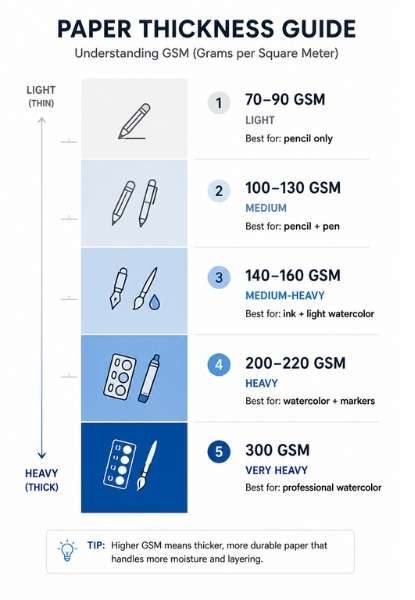
Here’s a simple reference guide:
| GSM Range | Paper Thickness | Best For |
| 70–90 GSM | Thin / Lightweight | Practice sketches, pencil only. Bleeds with ink or markers. |
| 100–130 GSM | Medium / Standard | Pencil, pen, colored pencil, light marker. Most beginner sketchbooks. |
| 140–160 GSM | Medium-Heavy | Pencil, ink, light watercolor washes, markers. Great all-rounder. |
| 200–220 GSM | Heavy | Watercolor, gouache, acrylic washes, mixed media. Handles lots of water. |
| 300 GSM | Very Heavy / Professional | Full watercolor with heavy washes. Rarely warps. |
For most beginners, 120–160 GSM is the sweet spot. It handles pencil, pen, and light watercolor washes well enough for everyday practice without being too heavy or expensive.
If you already know you love watercolor, go straight to 200 GSM or above you won’t regret it.
Sketchbook Binding Types: Which One Is Right for You?
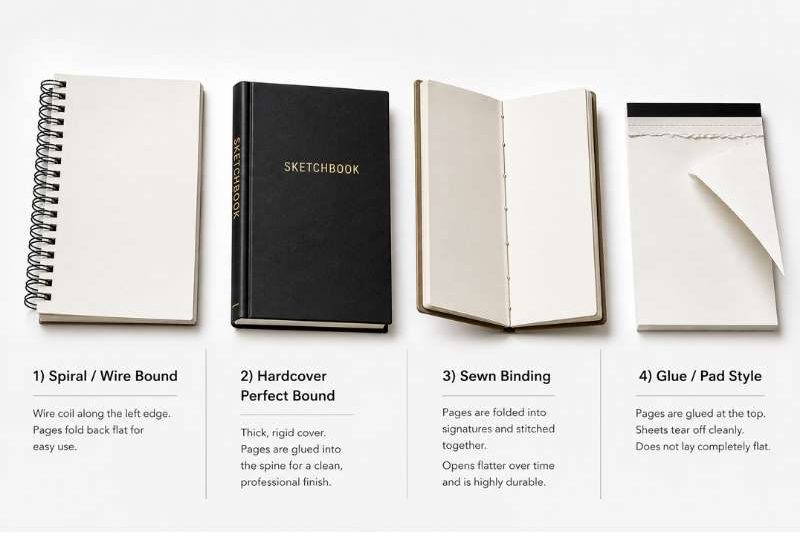
Binding affects how your sketchbook opens, how durable it is, and whether you can comfortably draw across two pages at once. It also affects how well the sketchbook holds up after months of daily use. Here are the main sketchbook binding types you’ll encounter.
Spiral-Bound (Wire-Bound) Sketchbooks
Spiral bound sketchbooks lie completely flat when open which is a bigger deal than it sounds. You can fold the pages all the way back on themselves, which is great for outdoor sketching when you’re working in a tight space.
Individual pages can also be removed easily, which is handy for sharing work or mounting finished pieces.
The downside: the wire coil can sometimes get in the way of your drawing hand, especially if you’re left-handed. They’re also harder to store neatly on a bookshelf. But for any artist who sketches on the go, spiral binding is honestly hard to beat.
Hardcover / Perfect-Bound Sketchbooks
A hardcover sketchbook is sturdy, protective, and looks great on a shelf. The rigid cover acts like a built-in drawing board, which means you can hold it in your hand and draw without needing a table underneath. That’s a huge practical advantage outdoors.
Some hardcover books open completely flat; others have a tight spine that fights you near the middle pages. Brands like Moleskine and Stillman & Birn are well-known in this category and have different qualities at different price points.
Hardcover is the best choice for long-term artwork archives and studio-quality sketchbooks you want to keep for years.
Sewn / Stitched Binding
Higher-end sketchbooks use sewn signatures sections of pages that are folded and stitched together before being bound into the cover. Books like this often open very flat and are exceptionally durable.
You’ll usually find sewn binding in premium sketchbooks from brands like Fabriano, Hahnemühle, or Leuchtturm. They cost more, but they last. If you want a sketchbook that feels like a real archive of your work, this is the binding to look for.
Glue-Bound / Pad Style
Pads use a simple adhesive binding pages are designed to be torn off individually. They’re fine for practice drawings and reference sketches, but I wouldn’t recommend a glue-bound pad as your main sketchbook.
\Pages can come loose over time, the binding doesn’t hold up with heavy use, and there’s no real sense of a continuous sketchbook experience. Save pads for loose practice sheets.
Sketchbook Size: How to Pick the Right One
Size is about how and where you draw. There’s no universally perfect size there’s the right size for your situation. Here’s a quick sketchbook size guide to help you decide:
Pocket / Small (A6 or Smaller)
A pocket sketchbook fits in a jacket pocket or small bag. It’s perfect for quick gesture drawings, journaling on the go, and capturing ideas when you’re out and about.
Not ideal for detailed work there just isn’t enough room. But as a carry-everywhere sketchbook that you can pull out anywhere, it’s unbeatable. Great as a second sketchbook once you have a main one.
A5 (Half of A4)
A5 is probably the most popular everyday sketchbook size among artists, myself included. Big enough for real drawing and detailed studies. Small enough to fit in any bag without taking over.
It’s a great balance between portability and actual drawing space. If you’re buying your first sketchbook and you’re not sure what size to get, start with A5. You’ll almost certainly love it.
A4 / Letter Size (8.5″ × 11″)
Standard desk size. Gives you plenty of room for detailed portrait studies, figure drawings, and compositions with real space to breathe. It’s not the most portable, but it’s excellent for home studio use. Most sketchbook brands offer their best paper types in A4, so you’ll have more options at this size.
A3 and Larger
A3 is for artists who like to work large big landscapes, full figure compositions, detailed reference drawings. It’s heavy and hard to carry. If you’re just getting started, I’d skip A3 for now.
Come back to it once you’ve filled a few smaller sketchbooks and you know your style well enough to know you need more space.
Quick recommendation: if you’re buying your first sketchbook, start with A5 or A4. They’re the most versatile, easiest to fill, and give you the most value for everyday practice.
Hard Cover vs Soft Coverm: Does It Really Matter?
Honestly, yes! but probably not as much as you think. Here’s the simple version:
Hard covers give you a built-in drawing board. You can hold the sketchbook in your hand while standing or sitting outdoors, without needing a flat surface underneath.
They’re also more protective for the pages inside. If you sketch outdoors, travel with your sketchbook, or do a lot of on-location drawing, hard cover is strongly recommended.
Soft covers are lighter, more flexible, and usually cheaper. Some soft cover books actually open flatter than hardcovers, which is a nice bonus.
For a sketchbook you keep at your desk at home and use for daily practice, soft cover is perfectly fine. It’s all about how and where you draw.
Other Things Worth Checking Before You Buy
Once you’ve figured out paper type, GSM, binding, and size, there are a few more things I always check before I commit to a sketchbook. These are easy to overlook but genuinely matter over time.
Is the Paper Acid-Free?
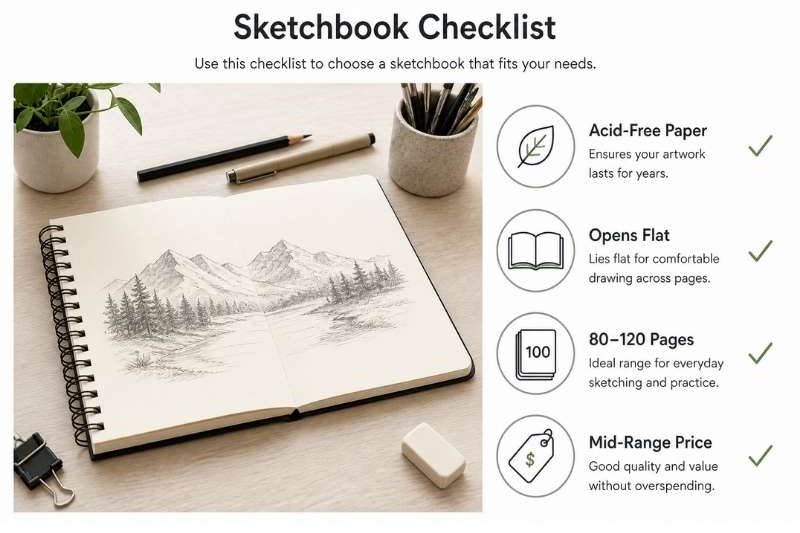
Acid-free paper doesn’t yellow or become brittle over time. Regular paper contains acids that slowly break down the paper fibers, and over the years, your sketches start to fade and disintegrate.
If you want your drawings to look the same in ten years as they do today, always choose acid-free paper. Most quality sketchbooks mention this clearly on the cover or packaging. It’s worth the five seconds it takes to check.
Does It Open Flat?
This is more important than most people realize, and it’s something you really need to test in person if you can. Open the sketchbook to the middle and see if the pages lie flat without you having to press them down.
A sketchbook that fights you near the spine makes drawing near the center of a page genuinely awkward, especially for portrait work where you need to work across the whole page comfortably.
How Many Pages Does It Have?
More pages means more practice time before you need a new book. But very thick sketchbooks can feel a little intimidating to fill when you’re just starting out.
For beginners, 60 to 100 pages is a great range that enough to build real momentum without feeling like you’ll never finish it. More experienced artists often prefer 120 to 200 pages, especially for daily sketchbooks.
Price vs Quality: What to Know
You don’t need the most expensive sketchbook to start drawing. A mid-range sketchbook in the $10 to $25 range gives you great paper for everyday practice.
Here’s something I genuinely believe: overly expensive paper can actually work against you as a beginner, because you start feeling like every drawing has to be ‘worth’ the expensive page.
A solid mid-range sketchbook lets you draw freely, experiment, and make mistakes which is exactly how you improve.
Save the premium sketchbooks for when you’ve developed your style and you want to archive finished work you’re genuinely proud of.
Quick Guide: Which Sketchbook Should You Buy?
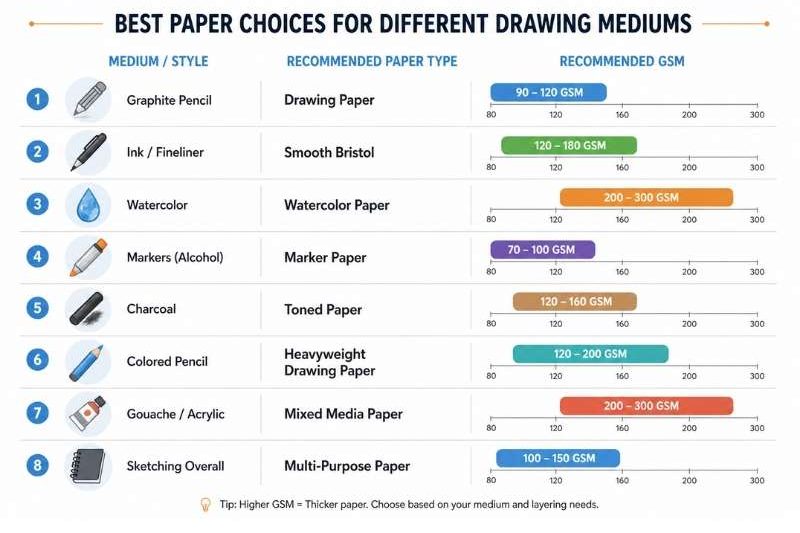
Use this quick guide to match your drawing style to the right sketchbook. If you’re not sure what your medium is yet, go for Mixed Media at 160 GSM it’s the safest, most flexible starting point.
| Your Medium / Style | Best Paper Type | Recommended GSM |
| Pencil & Sketching | Cartridge Paper | 100–130 GSM |
| Pen & Ink | Cartridge or Mixed Media | 120–160 GSM |
| Colored Pencil | Cartridge or Toned Paper | 100–160 GSM |
| Markers / Copic | Marker Paper or Mixed Media | 160–200 GSM |
| Light Watercolor Washes | Mixed Media | 160–200 GSM |
| Full Watercolor | Watercolor Paper | 200–300 GSM |
| Mixed / Not Sure Yet | Mixed Media | 160 GSM (safe choice) |
| Portraits & Highlights | Toned Paper | 120–160 GSM |
Best Sketchbook Features for Beginners: What I’d Tell a Friend
If a friend texted me right now and said ‘I want to start drawing, which sketchbook should I get?’ here’s exactly what I’d tell them. This is my personal beginner sketchbook buying guide, kept as simple and direct as I can make it.
- Start with a spiral-bound or softcover book. They’re lighter, less intimidating, and much easier to handle when you’re just getting comfortable with drawing every day.
- Choose A5 or A4 size. These two sizes cover almost every situation home practice, on-the-go sketching, portrait studies, everything.
- Go for 120–160 GSM paper. This is the safe beginner zone. It handles pencil, pen, and light ink beautifully, and it won’t let you down for everyday practice.
- Don’t buy the most expensive sketchbook first. You need room to make mistakes, try weird things, and draw badly without feeling guilty about the paper. Give yourself that freedom.
- Always buy acid-free paper even if you’re not planning to keep every drawing. Good paper habits start early, and acid-free sketchbooks are widely available at every price point.
- Try toned paper at least once. It genuinely changes how you think about light and shadow, and it makes portrait sketching feel like a completely different and exciting experience.
The best sketchbook for beginners is the one that makes you want to pick up a pencil every morning. Don’t overthink it — start drawing.
Frequently Asked Questions (FAQs)
What paper weight is best for a beginner sketchbook?
For most beginners, 120–160 GSM is the ideal range. It’s heavy enough to handle pencil, pen, and light ink without tearing or bleeding through, but not so thick that the sketchbook becomes heavy or expensive to use every day.
If you plan to use watercolors regularly, go up to 200–300 GSM to prevent the paper from warping when it gets wet. Most entry-level sketchbooks fall in the 90–130 GSM range, which is fine for dry media.
Should I get a spiral-bound or hardcover sketchbook?
It depends on where you draw most. If you sketch outdoors, in cafes, or on the go, a spiral bound sketchbook is usually the better choice — it lies flat on any surface and is easy to hold in one hand.
If you mostly draw at home, want your sketchbook to feel more permanent, or plan to archive finished work inside it, a hardcover sketchbook offers more protection and looks better on a shelf. Many artists keep one of each for different purposes.
What is ‘paper tooth’ in a sketchbook?
Paper tooth refers to the texture or surface roughness of the paper. Paper with more tooth, meaning a rougher surface- grips dry media like charcoal, pastel, and pencil better, which makes blending easier.
Smoother paper (less tooth) works better for fine-detail pen work and precise ink lines because there’s less friction. For general pencil sketching, a slight to medium tooth is the most versatile option and the most commonly found in everyday sketchbooks.
Can I use watercolor in a regular sketchbook?
Not easily, no. Regular cartridge paper at 90–130 GSM will buckle, warp, and may even tear when it gets wet. For watercolor, you need paper that is at least 200 GSM, preferably a dedicated sketchbook for watercolor at 300 GSM.
If you only want to use occasional light watercolor washes alongside pencil and pen work, a mixed media sketchbook at 160–200 GSM is a good middle-ground compromise that won’t warp badly with light water use.
Is acid-free paper important for a sketchbook?
Yes, especially if you want your drawings to last more than a few years. Paper that isn’t acid-free slowly turns yellow and brittle over time — the acids in the paper break down the fibers, and your artwork eventually fades and deteriorates.
Acid-free paper resists this aging process and keeps your sketches looking the same as the day you drew them. It’s widely available at every price point, so there’s really no reason not to choose it. Always check the label before buying.
What size sketchbook should a beginner buy?
Start with an A5 (approximately 5.5 × 8.5 inches) or A4 (approximately 8.3 × 11.7 inches) sketchbook. A5 is the most popular everyday size it fits in any bag, it isn’t intimidating to fill, and it gives you enough space to practice real drawing. A4 is better if you like more room on the page for detailed work or portrait studies.
Avoid very large sizes like A3 until you’ve filled a few smaller sketchbooks and you have a clear sense of your style and needs.
Finally Making the Right Choice
So that’s everything you need to know about what to look for when buying a sketchbook. To quickly recap what actually matters: paper type, paper weight (GSM), binding style, size, and whether the paper is acid-free.
Those five factors will tell you almost everything about whether a sketchbook is right for your needs.
The perfect sketchbook isn’t the most expensive one or the prettiest one on the shelf. It’s the one that works for your specific medium, your drawing habits, and your lifestyle.
A $15 spiral-bound A5 with 140 GSM paper beats a $60 premium hardcover if the latter has the wrong paper for what you’re drawing.
Take your time, use the tables in this guide, and trust your instincts. Once you’ve found a sketchbook that feels right, commit to it, fill every page, and then fill another one. That’s where the real progress happens.
If you’re not sure where to start with tools, I’d recommend also checking out our guide to the best pencils for sketching it pairs well with everything we’ve talked about here.
And if you want structured ways to actually fill your sketchbook, our drawing exercises for beginners will give you plenty to work with.