
If you’ve ever stood in an art store holding a single Copic Sketch marker, looked at the $8 price tag, and felt genuinely paralyzed I get it. I’ve been there.
I’ve also been on the other side of that moment, having bought both, used both for years, and watched students make expensive decisions they later regretted.
This copic vs prismacolor markers comparison is the one I wish someone had handed me a decade ago, before I blew money I didn’t have on a system I wasn’t ready for.
Most comparison articles will give you a chart. Ink type: alcohol. Price: Copic costs more. Refillable: yes/no. They’re not wrong. They’re just not useful. Because none of that tells you what matters – which one is right for where YOU are right now.
I’ve been drawing and illustrating professionally for over ten years. I’ve run workshops in the U.S., worked with students from complete beginners to working professionals, and I’ve put serious hours into both marker systems. Here’s what I actually think.
What Nobody’s Comparing (And Why It Matters)
Here’s the thing about every copic vs prismacolor markers comparison you’ve read before this one: they compare specs when they should be comparing experiences.
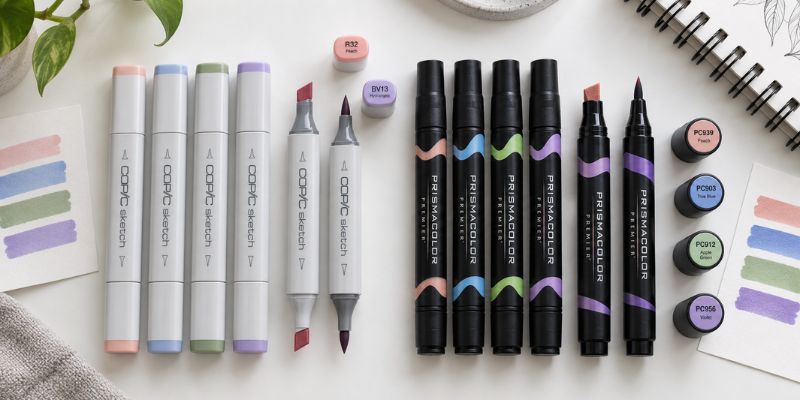
Both Copic and Prismacolor Premier markers are alcohol markers. Both blend. Both come in dual-tip versions. If you put a swatch of each on the same marker paper and photographed them from ten feet away, a lot of people couldn’t tell which was which, especially in early layers.
So why does the debate feel so charged? Because the real differences show up over time, under pressure, at scale.
They show up when you’re working on a large illustration for six hours and need exact color consistency. They show up when a nib frays at 11pm and you need to finish a commission. They show up in your bank account.
That’s what I want to talk about. Not the specs. The reality.
The Copic System – What It Gives You (And What It Costs You)
Let’s start with Copic because it’s the one people agonize over.
Copic Sketch markers give you access to 358 colors. That’s not a selling point I’m throwing out casually – that’s the widest standardized color range of any professional alcohol marker system on the planet.
Each color has a number. E35 is a specific warm skin tone. B45 is a specific cool blue. You can walk into an art store in New York, Tokyo, or São Paulo and find the exact same E35. That kind of consistency is genuinely valuable when you’re building a professional practice.
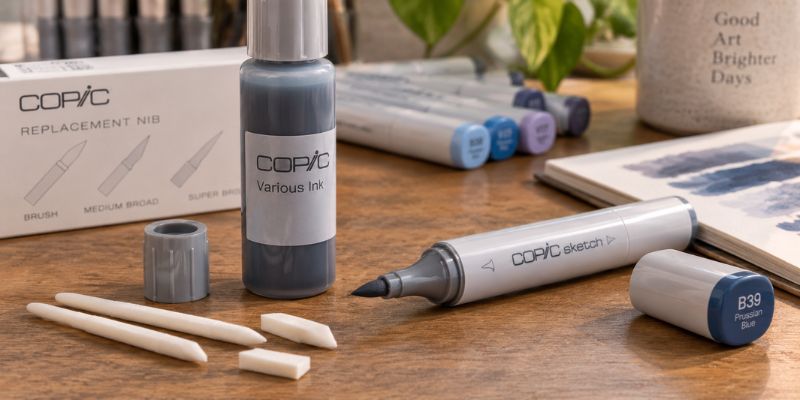
The refill system is real and it works. One Copic Various Ink bottle runs about $7-12 and can refill a marker 8-15 times depending on how much ink was left.
The nib replacement system means a worn-out broad nib doesn’t mean a dead marker – you swap it out for $3-5 and keep going. Over years of use, the math tilts toward Copic if you’re using markers regularly.
And that’s why Copic markers cost so much upfront – you’re not just buying a marker, you’re buying into a system.
But here’s the honest part: that system only pays off if you use it. And that’s the trap.
A 12-marker Copic set will run you $75-100. A 36-marker set is $180-250 depending on where you buy. The markers are just the beginning. You need Copic-compatible paper (regular sketchbook paper bleeds and pills with alcohol markers).
You’ll want Copic 0 colorless blender, which costs around $7-9 and is basically mandatory for clean gradients. If you’re serious, you’ll eventually want a storage solution because Copic markers don’t just throw well in a pencil case.
None of that is a reason not to buy Copics. For the right person, it’s worth every penny. But you need to walk in clear-eyed about what “getting into Copics” actually costs.
The Prismacolor Reality – Underrated in the Best Way
Prismacolor Premier markers don’t get the respect they deserve. Full stop.
Here’s what I mean. A Prismacolor Premier marker runs $2-4 each depending on where you buy. That means for the price of 10 Copic markers, you can buy 30-40 Prismacolors.
You can build a legitimately wide color palette for under $60. You can make mistakes, experiment with colors you’re not sure about, and not feel like every dried-out marker is a small financial tragedy.
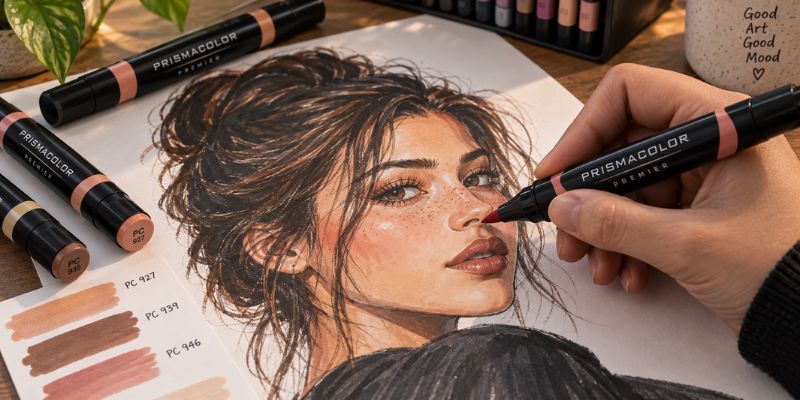
The brush tip on Prismacolor Premier is genuinely excellent. It’s flexible, responsive, and holds detail well. The ink is rich – colors like their warm reds and deep purples are vivid in a way that surprises people the first time.
For the full Prismacolor review including individual set breakdowns, I’ve covered that separately. But as part of this comparison: Prismacolor performs far above its price point, especially for illustrative and expressive work.
The limitations are real, though, and I won’t pretend otherwise. Prismacolor markers aren’t refillable. When they’re gone, they’re gone – you buy a replacement. The nibs can fray with heavy use, particularly on textured paper.
And I’ve occasionally noticed slight color variation between batches of the same marker if I’m buying at different times. For casual and educational use, none of this is a dealbreaker. For professional work where color consistency matters across a series? It can become an issue.
Prismacolor’s actual sweet spot is the artist who wants real quality alcohol markers without committing to the Copic ecosystem – students, hobbyists building a color library on a reasonable budget, artists who use markers as a complement to other media rather than as their primary tool.
The Blending Test – Where They Actually Differ
This is where the real difference lives. Not in the swatches. In the blending.
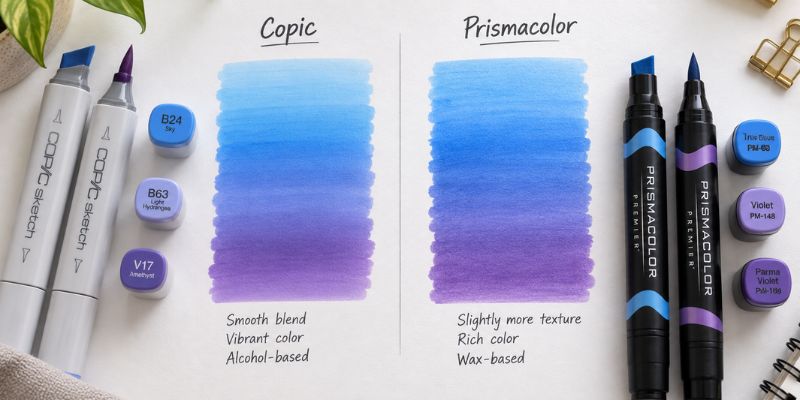
Copic’s ink chemistry is specifically engineered for seamless layering. The ink stays workable longer, which means you have more time to push colors together before they dry.
When you add Copic 0 colorless blender, you can pull color into clean gradients with a level of control that’s hard to achieve with any other marker system.
Skin tones, especially, respond beautifully – manga artists have built entire careers on what Copic can do with a five-marker skin set and good technique.
Prismacolor blending is solid, not seamless. You get the best results with a fast layering approach – lay down your light colors, hit them with your dark colors while the first layer is still slightly damp, then blend back with a colorless blender.
It takes more deliberate technique. The margin for error is smaller. I wouldn’t call it harder exactly, just less forgiving.
Paper matters equally for both. Neither works well on copy paper or standard sketchbook paper – you’ll get bleed-through and the ink won’t move cleanly.
I recommend Canson XL marker paper (around $14 for a 50-sheet pad) or Strathmore 400 Series marker paper for learning. Once you’re going deeper, look into the best paper for alcohol markers – the right paper makes a bigger difference than most people expect.
For Copic’s full color numbering system and ink chemistry documentation, Copic’s official site is the authoritative source – worth bookmarking if you’re committing to their system.
The Question You’re Actually Asking – Which One Should You Buy?
Okay. Direct answer. No “it depends” cop-outs.
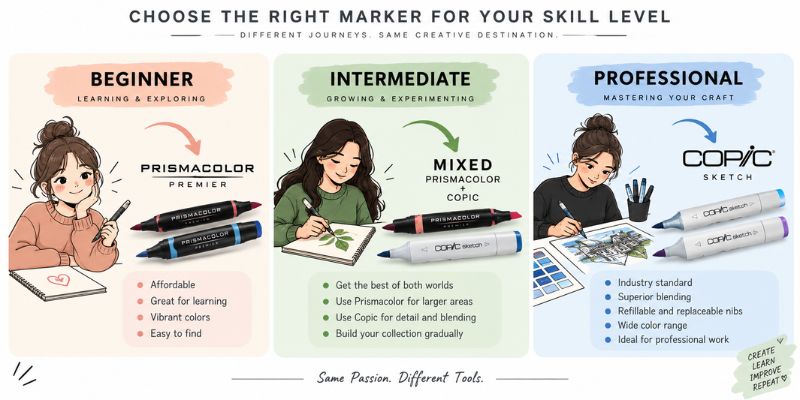
If you’re just starting out with alcohol markers, start with Prismacolor. Get a 24 or 36-color set, pick colors you actually want to work with, and learn the technique. Here’s the thing most people don’t say: the skills you build with Prismacolor are exactly the same skills you’ll use with Copic.
Layering, blending, working light to dark, understanding how alcohol ink moves on paper – none of that changes when you switch brands. You don’t need to pay a Copic premium to develop the fundamentals.
If you’re intermediate and you’re using markers consistently – meaning you’re reaching for them weekly, you’ve worked through a set or two, and you know this is a real part of your practice – start building into Copic selectively.
My recommendation: start with a Copic skin tone set and a gray set. Those are the ranges where Copic’s blending superiority shows most clearly, and they’re the workhorses of illustrative work.
Keep your Prismacolors for secondary and accent colors. A mixed toolkit isn’t a compromise. It’s smart.
If you’re professional or working toward it, Copic is the industry standard. That’s not marketing. It’s what commercial illustrators use, what animation concept artists use, what most working manga and webtoon artists use.
When you need to spec a color for a client, match a reference exactly, or maintain consistency across 50 pages, Copic’s numbered system earns its place.
I had a student – talented, motivated, probably one of the best in the beginner workshop I ran a few years back – who spent close to $300 on a Copic set in her first month. She was all in.
And by month three, she’d put the markers away and moved on to something else. Not because the markers were bad. Because she hadn’t built the practice yet. The skills, the habits, the actual sitting-down-and-drawing time.
The markers didn’t fail her. The timing did. I think about her every time someone asks me whether they should buy Copics on day one.
Hidden Costs Nobody Mentions
This section exists because I’ve never once seen a copic vs prismacolor markers comparison article include it. So here it is.
Copic hidden costs:
Copic-certified or marker-grade paper. Regular sketchbooks don’t work well – the ink bleeds and moves unpredictably. Budget $14-20 for a good marker pad. Copic 0 colorless blender: $7-9 each, and you’ll go through several per year if you blend frequently.
Replacement nibs: $3-5 each, and broad nibs on heavily used markers can wear within 6-8 months of serious work. If you build a large Copic set (72+ markers), you’ll need a proper storage case or rolling cart – budget $30-80 depending on the solution.
Over two years of regular use, a 36-marker Copic set’s actual total cost of ownership (including refills, nibs, paper, and blender) runs roughly $350-500.
Expensive, but spread over two years and with the refill model extending how long Copic markers last, the per-use cost drops significantly.
Prismacolor hidden costs:
Replacement markers. Every dried-out or fully-spent Prismacolor is a new purchase – $2-4 per color. Over two years of regular use, you might replace 20-30 individual markers depending on how often you use certain colors.
That’s $60-120 in replacement costs on top of your initial purchase. The same paper investment applies – good marker paper matters regardless of brand.
Total two-year Prismacolor cost for a comparable color range: roughly $150-250 including replacements and materials. Significantly lower, even accounting for non-refillability.
One more thing: Copic wins on sustainability. The Prismacolor official site doesn’t emphasize this, but Copic’s refillable system produces a fraction of the plastic waste of non-refillable markers.
If that matters to you – and for a lot of artists it increasingly does factor it in.
After 10+ Years With Both, Here’s Where I Land
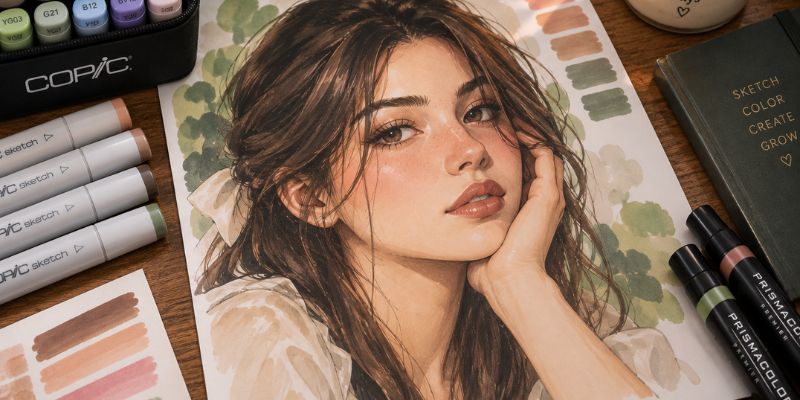
I reach for Copics when precision matters. Long sessions, portrait work, anything where I need seamless skin tone gradients or exact color matching across a series. The system is reliable in a way that I’ve come to depend on.
I reach for Prismacolor when I’m experimenting. New compositions, color studies, trying things that might not work. At $2-4 a marker, failure is cheap. That’s not a knock – that’s a real feature.
The honest truth of this copic vs prismacolor markers comparison is that neither brand is “better.” They’re better at different things, at different stages, for different kinds of work.
The mistake people make is treating this as a one-time permanent choice rather than a decision that evolves with their practice.
Prismacolor’s brush tip feel that flexibility and responsiveness is genuinely impressive for what it costs. A lot of artists who move to Copic still keep their Prismacolors in the bag. I do.
The rich, saturated colors in the warmer range are something I still go back to.
And Copic’s color system, when you’re deep into it and working consistently? The investment clicks into place. The colors are where you expect them to be. The gradients land exactly where you aimed. It earns it.
If you’re still unsure where you fall, here’s my honest suggestion: start with a Prismacolor 24-set. Pick a color range you’ll actually use skin tones if you do portraits, cool blues and greens if you prefer landscapes and objects.
Work through the set. Use them until you know whether you’re still reaching for markers three months from now. If you are, we can talk about Copics. If you’re not, you spent $35 instead of $250 finding out.
That’s the honest answer. Not a chart. Not a verdict. Just ten years of experience compressed into a starting point for wherever you are right now.